Showing posts with label pastel. Show all posts

Saturday, 23 March 2013


Unfortunately we have experienced technical problems with the new Wordpress blog so we have decided to continue with our blogs on this site. We are sorry if you have signed up for the new blog but not received notification of new posts. We just can't make it work!
David and I are opening our exhibition at Art Matters in Tenby on Easter Saturday, if you are in the area please do come and say hello.
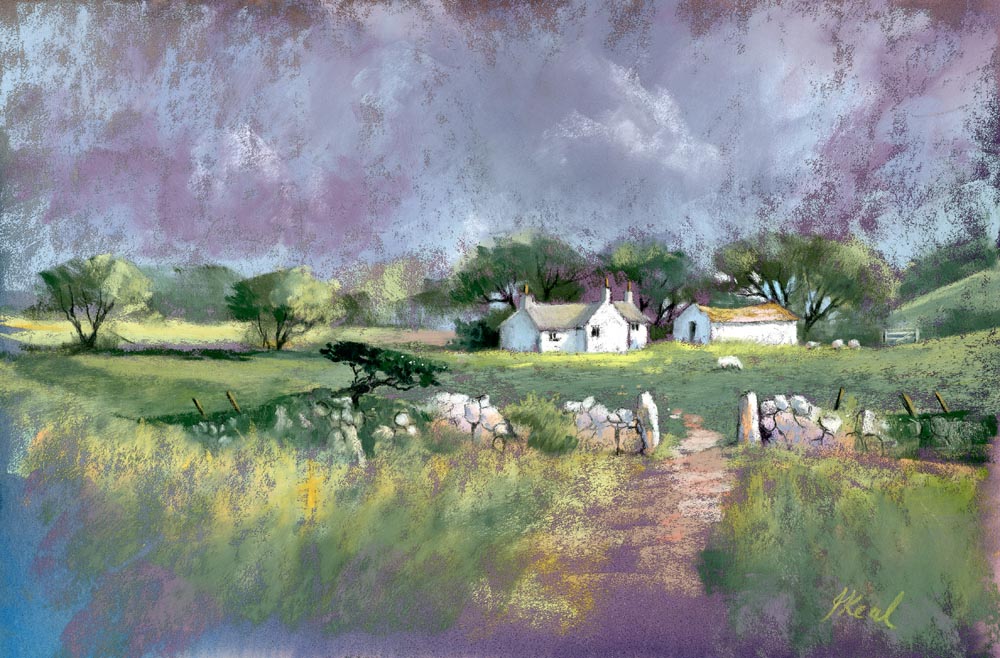
The western fringes of the British Isles, have always exerted a strong influence on my painting. The stories, myths and legends, the ancient stones and the marks left by prehistory are evident everywhere. The cottages and farms, hunkered down among the rocks in their struggle to survive the Atlantic fury, show clear evidence of the ingenuity of past generations. Even today, in many places, the same building methods are used to protect homes from the violence of the weather.
Farm Above Dinas Cross JK s
Farm above Dinas Fach, Pembrokeshire

In Pembrokeshire especially, the buildings have a unique character, that  makes them a gift for the artist. Like many other painters I am bewitched by this charm. The rugged coastline provides a never-ending bounty of subjects. At every twist and turn of the shoreline another inspiring view appears.
I am fortunate indeed that Pembrokeshire is David’s home county. Through his intimate knowledge of every nook and cranny we have explored fascinating and stimulating places and although we have travelled the world together, it is to Pembrokeshire that I always long to return.

Sunday, 3 June 2012

Sketching on Skye


David and I have just returned home from a trip to Skye. We stayed with Rosemary Hale in Aird of Sleat at her lovely coft house for a few days and for me it was sketching heaven with traditional buildings in every direction against a backdrop of mountains and islands. 


Half Seventeen in Aird of Sleat where we stayed with Rosemary
There were so many scenes to sketch that I had to work very quickly. In these circumstances I often create outline sketches in the field so that I can capture more compositions, and add watercolour washes to these in the evenings. That way I have plenty of material to work from when I return home and return with a feeling of having done justice to the plethora of subjects.

Lower Breakish, Sketch done out of doors in about 10 minutes
Lower Breakish, Watercolour washes added the same evening
By adding the watercolour washes to the sketch the same evening, the colours are still fresh in my mind. Sometimes I make colour notes on the pencil sketch to remind me. Working this way I can produce 5 or 6 sketches a day instead of just one. This sketch was done on a walk along the shore at Lower Breakish.

Towards the end of our stay on Skye we spent a couple of nights with Helen Stephensen at her superb Bed and Breakfast, Sealladh Alainn,  in Lower Breakish. The views from the breakfast table across the Loch were stunning with subjects to draw and paint in every direction.
View from the breakfast table at Sealladh Alainn

David and I are both demonstrating at Patchings Art Festival on 14th and 15th June. Come along and say hello to us there.

Friday, 3 February 2012

Pastel Dust Control

The most common criticism of painting in pastel is the problem of dust. This can be a concern if you have breathing problems or are sensitive to dust . I am asthmatic myself. However there are a number of methods of reducing the dust considerably.

On the right is a page from my new book, Painting with Pastel, which reproduces my studio set up. (copyright Paul Bricknell and Search Press)

My three point dust reduction plan is as follows:-

1. Always work with the painting vertical on an easel with a right angled channel, (cardboard or plastic) under the drawing board. This allows the pastel dust to drift down into the channel and you do not have to blow away the excess pastel as you would if the painting was at a shallower angle. If you don't like standing you can use a desk easel, but keep the painting vertical. You can make an angled channel with a length of mountboard. At the end of a painting session I rarely have more than a quarter of a teaspoon of dust in the channel.

2. Keep a dry flannel in your hands while you are working. This serves two purposes; it keeps your hands relatively clean and you can clean any grubby sticks as you work so that you can identify the colours easier.

3. Work on fine sandpaper; the abrasive quality of the surface grips the pastel and produces less dust than working on paper. Sandpaper also encourages you to work 'thin', i.e. use fewer layers of pastel. I find the colours are more vibrant on sandpaper and there is no need to build up layers to get depth of colour.

You will notice in the photograph there is also an old towel on the floor, this also absorbs any dust and prevents dropped pastels from breaking. The towel on the table helps to keep the pastel sticks clean.

The tools in the holder hanging from the easel include colour shapers for blending, brushes for removing mistakes and palettes knives for creating the spatter effect (more on that in another post) etc.

I have been experimenting with Pan Pastels, as you will see from some of my other posts, and have found that they produce much less dust than stick pastels. The method of working in Pan Pastel is quite different from stick pastel and a number new techniques need to be developed. If you want to see some of these, I have an article in the March 2012 issue of Leisure Painter Magazine. (available now)